


Top Property Management Financial Reporting Issues and How to Fix Them

Property management financial reporting is often assumed to be accurate as long as the numbers are complete in the system. Rent is recorded, expenses are entered, and reports are generated every month. On the surface, everything looks fine.

The problem starts when those reports are built on inconsistent data. Small errors in classification, timing, or reconciliation can slowly distort the financial picture. Over time, these issues affect decision making, owner trust, and the reliability of reporting.
Many property managers only notice these problems when discrepancies appear in owner statements or bank reconciliations. By then, the root cause has already spread across multiple reporting cycles.
Why Property Management Financial Reporting Issues Can Lead to Costly Mistakes
Financial reporting issues are not just technical errors. They directly affect how property performance is understood and communicated. When reports are inaccurate, every decision based on them becomes weaker.
In property management, reports are used for owner communication, budgeting, and cash flow planning. If those reports are flawed, managers risk making decisions based on incomplete or misleading information. This can lead to disputes, delayed decisions, and financial stress.
The real risk is not visible immediately. It builds gradually through repeated small mistakes that go unnoticed until reports no longer align with actual financial activity.

What Are the Top Property Management Financial Reporting Issues Property Managers Face?
Many reporting issues come from daily operational habits rather than major system failures. These problems often develop slowly and are difficult to detect without careful review.
Below are the most common issues that impact accuracy and clarity in property management reporting.
Misclassified income and expenses
Transactions are often recorded in the wrong category due to unclear definitions or rushed data entry. This leads to distorted financial reports that do not reflect actual property performance.
Incomplete or delayed bank reconciliation
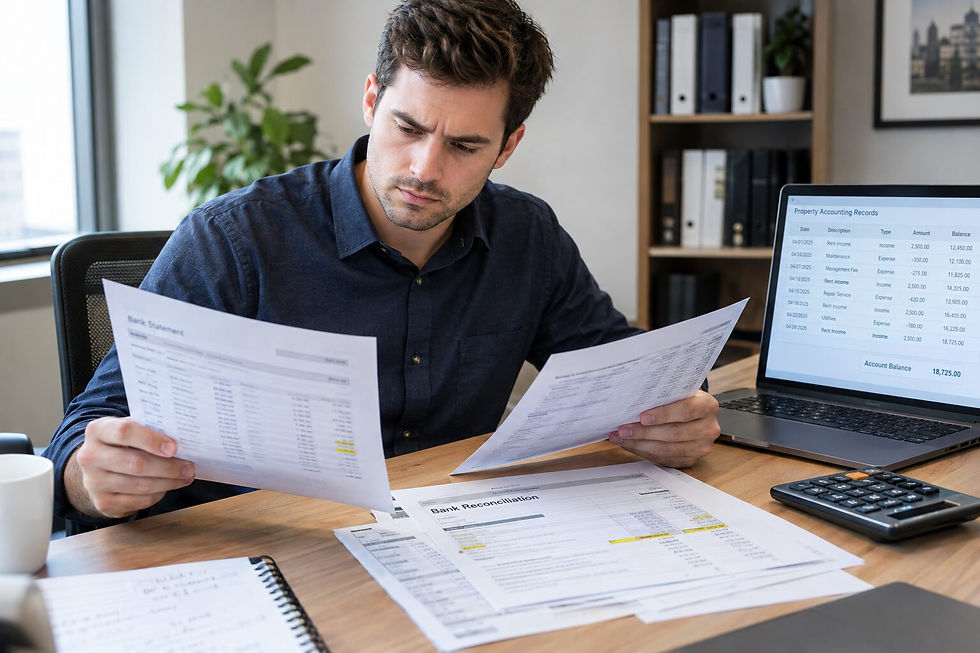
Bank accounts are not always reconciled regularly or thoroughly. This creates gaps between system records and real bank activity.
Incorrect property level allocation
Income and expenses are sometimes recorded at the portfolio level instead of the correct property. This removes visibility into individual property performance.
Missing or duplicated transactions
Transactions can be skipped during entry or entered more than once by mistake. This results in inaccurate totals and unreliable reports.
Weak chart of accounts structure
A poorly structured chart of accounts makes it difficult to categorize transactions consistently. Over time, this creates confusion in reporting and analysis.
Overreliance on automation without review
Automated systems are trusted without regular manual checks. This allows small syncing or mapping errors to go unnoticed.
How Do Financial Reporting Issues Affect Property Management Owner Statements and Reporting?
Financial reporting issues directly impact the accuracy of property management owner statements and reporting. Since owner statements are built from underlying financial data, any inconsistency in tracking flows directly into what owners see.
When income or expenses are misclassified, owner statements may show incorrect profitability or cash flow. This often leads to confusion and questions from property owners, especially when numbers do not match expectations.
Over time, repeated inaccuracies can damage trust between property managers and owners. Even if errors are small, consistency issues create the impression of poor financial control. This is where many firms begin to lose client confidence.
Strong reporting discipline is essential to ensure that every owner receives clear, accurate, and transparent financial updates.

Where Do Property Managers Go Wrong When Managing Financial Reports?
Most reporting issues do not come from lack of effort. They come from process gaps and inconsistent habits that build up over time.
Property managers often focus on completing reports quickly rather than verifying accuracy. This creates shortcuts that may save time in the short term but lead to larger problems later.
Another common issue is relying too heavily on software outputs without reviewing underlying data. Systems can only be as accurate as the information entered into them.
Without proper checks and structured workflows, even experienced teams can produce unreliable financial reports.
How Can Property Managers Fix and Prevent Financial Reporting Issues?
Fixing reporting issues requires more than correcting errors. It requires improving the system that created them in the first place.
The first step is strengthening reconciliation processes. Regular bank reconciliation ensures that system records match real financial activity. This reduces hidden discrepancies.
Next is standardizing categorization rules. Clear definitions for income and expenses help ensure consistent data entry across the entire portfolio.
It is also important to review reporting structures regularly. Reports should reflect real business needs, not just system defaults. Adjusting reports improves clarity and decision making.
Many firms also improve accuracy by refining their internal workflows and applying better financial strategies to support long term consistency.
Why Do Many Property Managers Rely on Professional Accounting Services for Accurate Reporting?
As portfolios grow, reporting becomes more complex and time consuming. Many property managers eventually reach a point where internal processes are not enough to maintain accuracy.
Working with WPM Accounting helps property managers build structured systems that reduce reporting errors and improve financial clarity. With experience across different platforms and portfolios, the focus is on long term accuracy rather than quick fixes.
Professional accounting services for property managers also help standardize workflows, improve reconciliation practices, and ensure reporting consistency across multiple properties.
Many firms also choose to outsource real estate accounting services to reduce internal workload and improve financial reliability. This allows property managers to focus on operations while ensuring their reporting remains accurate and compliant.
Conclusion
Property management financial reporting issues often start small but grow into serious challenges if not addressed early. Most problems come from inconsistent tracking, weak reconciliation, and unclear categorization rather than system limitations.
When reporting is inaccurate, it affects everything from owner statements to financial planning. The key is not just fixing errors but improving the structure behind them.
Property managers who prioritize accurate tracking and consistent reporting workflows gain better control over their portfolios and reduce long term financial risk.
Key takeaways:
Reconcile accounts regularly to avoid hidden discrepancies
Standardize income and expense categories across all properties
Review owner statements for consistency and accuracy
Avoid relying on automation without verification
Strengthen internal reporting workflows for long term stability

FAQs About Property Management Financial Reporting Accuracy
What is the most common cause of property management financial reporting issues?
The most common cause is inconsistent tracking of income and expenses, often due to misclassification or weak reconciliation practices. These small errors accumulate and affect overall reporting accuracy.
How do financial reporting issues affect property management owner statements and reporting?
They lead to incorrect or incomplete owner statements, which can cause confusion and reduce trust. Since statements rely on underlying data, any error in tracking directly impacts reporting accuracy.
Can financial reporting issues be fixed without changing accounting systems?
Yes, many issues can be resolved by improving workflows, reconciliation processes, and data consistency. However, in some cases, system restructuring may also be needed.
How often should property managers review financial reports?
Most property managers should review reports monthly, along with regular reconciliation checks. Frequent reviews help identify issues early before they become larger problems.
How can WPM Accounting help improve financial reporting accuracy?
WPM Accounting helps property managers improve reporting accuracy by structuring accounting systems, correcting inconsistencies, and applying professional accounting services for property managers to ensure long term financial control.


Comments